How to put AI to work for your members and staff in medical fitness

Medical fitness centers are uniquely positioned at the crossroads of clinical care, preventive health, and wellness engagement. Unlike traditional gyms, these facilities are medically integrated, focusing on chronic disease management, individualized care, comprehensive screening, and educational programming that improves long-term health outcomes.
This hybrid model requires technology that supports both clinical workflows and operational excellence.
As highlighted in our recent webinar, AI is no longer a future concept for fitness operators. It is already becoming foundational. In fact, 88 percent of clubs plan to adopt AI by 2026, with many already using it for scheduling, retention, and workload management. The real question is no longer whether to adopt AI, but how to operationalize it effectively.
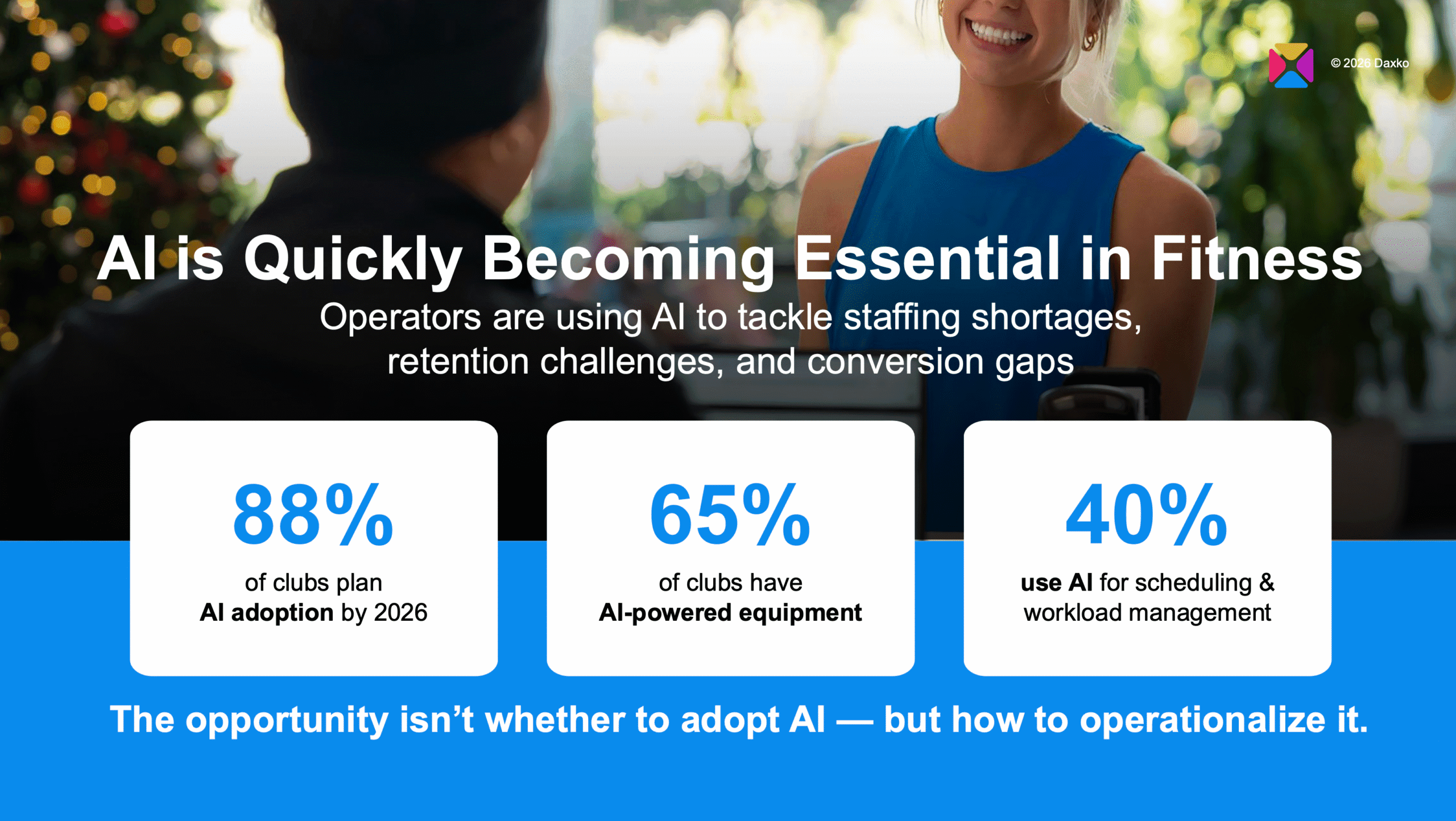
AI Adoption Stats
Understanding AI in medical fitness: Practical, not theoretical
AI often brings to mind complex or futuristic systems, but in medical fitness, its role is much simpler and more practical. Think of AI as an operational assistant that clears the path for staff to focus on member support and program delivery.
In day-to-day operations, AI helps by:
- Identifying patterns in member behavior
- Generating communications and summaries
- Automating routine workflows
- Supporting decision-making with real-time insights
Rather than replacing human expertise, AI complements it. Staff continue to lead with empathy, coaching, and clinical judgment, while AI supports the operational layer.
Human expertise vs AI assistance
| Human expertise | AI assistance |
|---|---|
| Clinical decision-making | Drafting messages and communications |
| Coaching and program guidance | Identifying members who need outreach |
| Member relationships | Summarizing reports and data |
| Professional judgment | Triggering reminders and follow-ups |
| Trust and empathy | Organizing information across systems |
This balance ensures that care remains human, while operations become more efficient.
Where AI delivers everyday value across the member journey
AI delivers the most value when applied to real, repeatable workflows across the member lifecycle. One of the most important insights from the webinar is the shift from reactive workflows to real-time, intent-driven engagement.
From reactive to real-time operations
| Traditional approach | AI-enabled approach |
|---|---|
| Missed sessions reviewed weekly | Missed sessions trigger immediate outreach with reschedule links |
| Referrals sit in inboxes | Referrals receive same-day welcome messages |
| Member questions answered inconsistently | Auto-responses provide consistent answers instantly |
This shift dramatically improves responsiveness, consistency, and member experience.
The first 30 days where retention truly begins
One of the most critical insights from the webinar is that the first 30 days define long-term retention.
Members who feel supported early are far more likely to stay engaged.
AI enables consistent, timely touchpoints without increasing staff workload. A typical AI-supported engagement journey might look like:
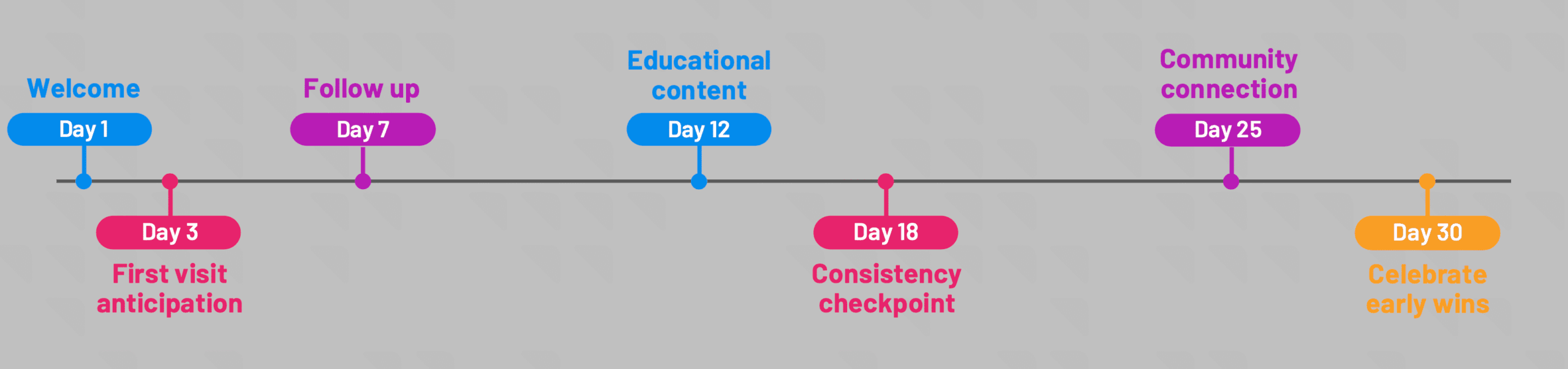
30-Day Journey
Instead of relying on manual follow-ups, AI ensures every member receives the right message at the right time.
Practical use cases across operations and engagement
- Member engagement and retention — AI identifies at-risk members based on behavior patterns and triggers proactive outreach before disengagement happens.
- Reactivating leads and churned members — AI can automatically segment members based on inactivity and trigger personalized outreach sequences within minutes rather than days.
- Administrative efficiency — Routine tasks such as billing reminders, scheduling confirmations, and reporting summaries can be automated, reducing manual workload.
- Outcomes reporting — AI transforms complex data into leadership-ready summaries, helping demonstrate program impact and justify investments.
Why unified data and modern technology matter for AI
AI is only as useful as the data it has access to. In fragmented technology environments, insights can be delayed, incomplete, or inaccurate. That’s where a modern platform purpose-built for complex operations, such as Daxko Club Automation, makes a difference.
In unified platforms like Daxko Club Automation, AI can operate across:
- Scheduling and program participation
- Billing and revenue data
- Member engagement and communication
- Outcomes and reporting
This enables a more advanced capability: dynamic segmentation and intelligent automation.
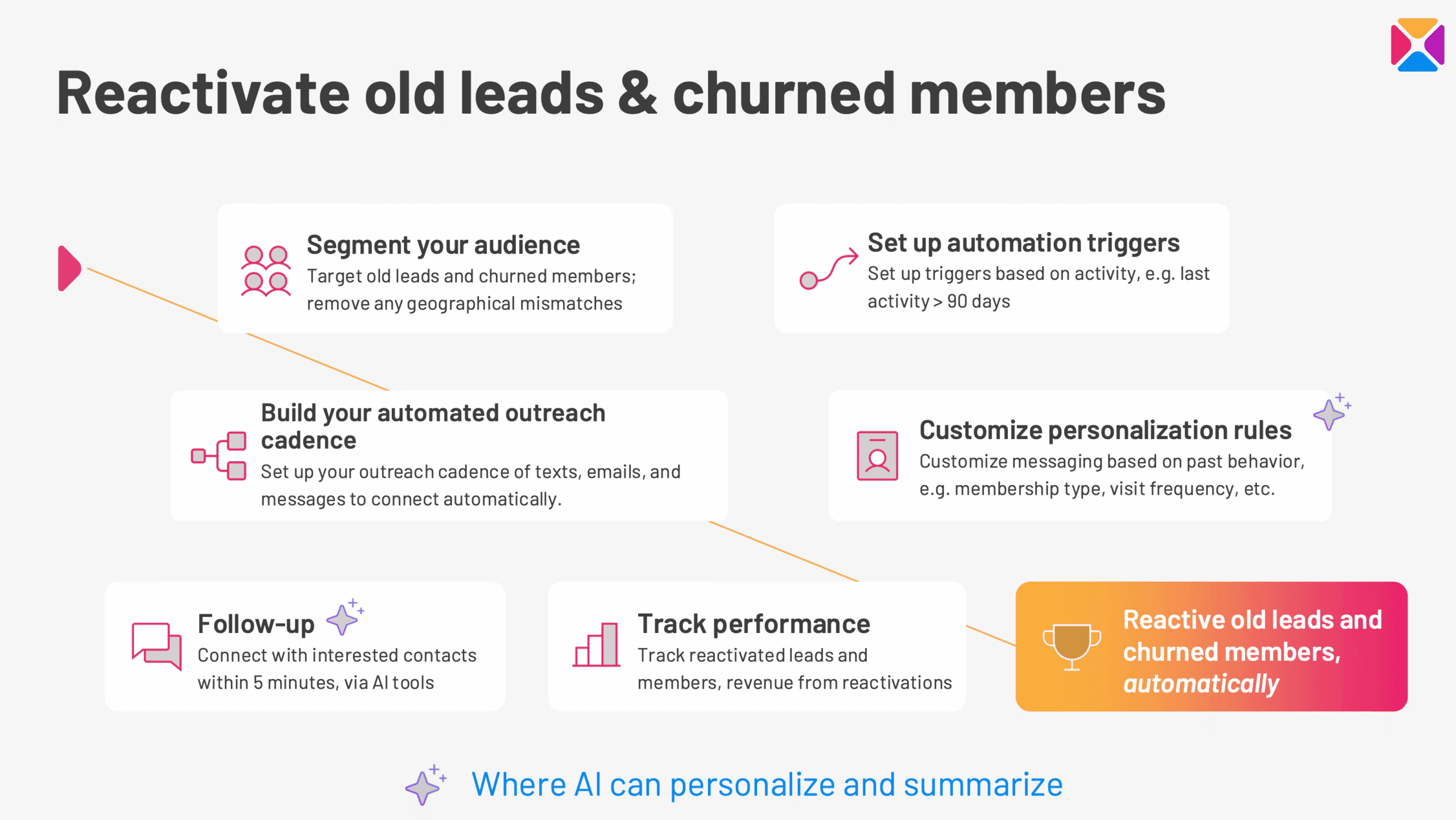
Reactivation workflows
For example:
- Members can be automatically grouped based on behavior such as churn risk or engagement level
- Outreach campaigns adjust in real time based on member activity
- Messaging is personalized without manual segmentation
This creates a system that moves from static reporting to continuous, real-time decision-making.
Guardrails and responsible AI in medical settings
AI must be implemented thoughtfully, especially in healthcare-adjacent environments.
The webinar emphasized three essential guardrails:
- Use AI for operational support — AI is best suited for communication, scheduling, reporting, and operational insights, not clinical decision-making.
- Maintain human oversight — All member-facing communication, reports, and policy explanations should be reviewed by staff before being shared.
- Protect member data and privacy — AI should operate within secure platforms that already manage permissions, payments, and sensitive information.
Additionally, AI-generated content should be treated like any other operational content. It should be reviewed regularly, updated for accuracy, and adapted for different member populations.
A practical approach to getting started with AI
One of the most actionable parts of the webinar was a simple framework for AI adoption.
Rather than trying to transform everything at once, successful organizations start small and scale.
A simple AI adoption workflow
- Choose one or two workflows such as outreach or reporting
- Define the current process and identify inefficiencies
- Test AI with real examples
- Review outputs for accuracy and tone
- Standardize successful prompts and workflows
- Roll out and track impact over two to four weeks
- Refine and expand to additional workflows
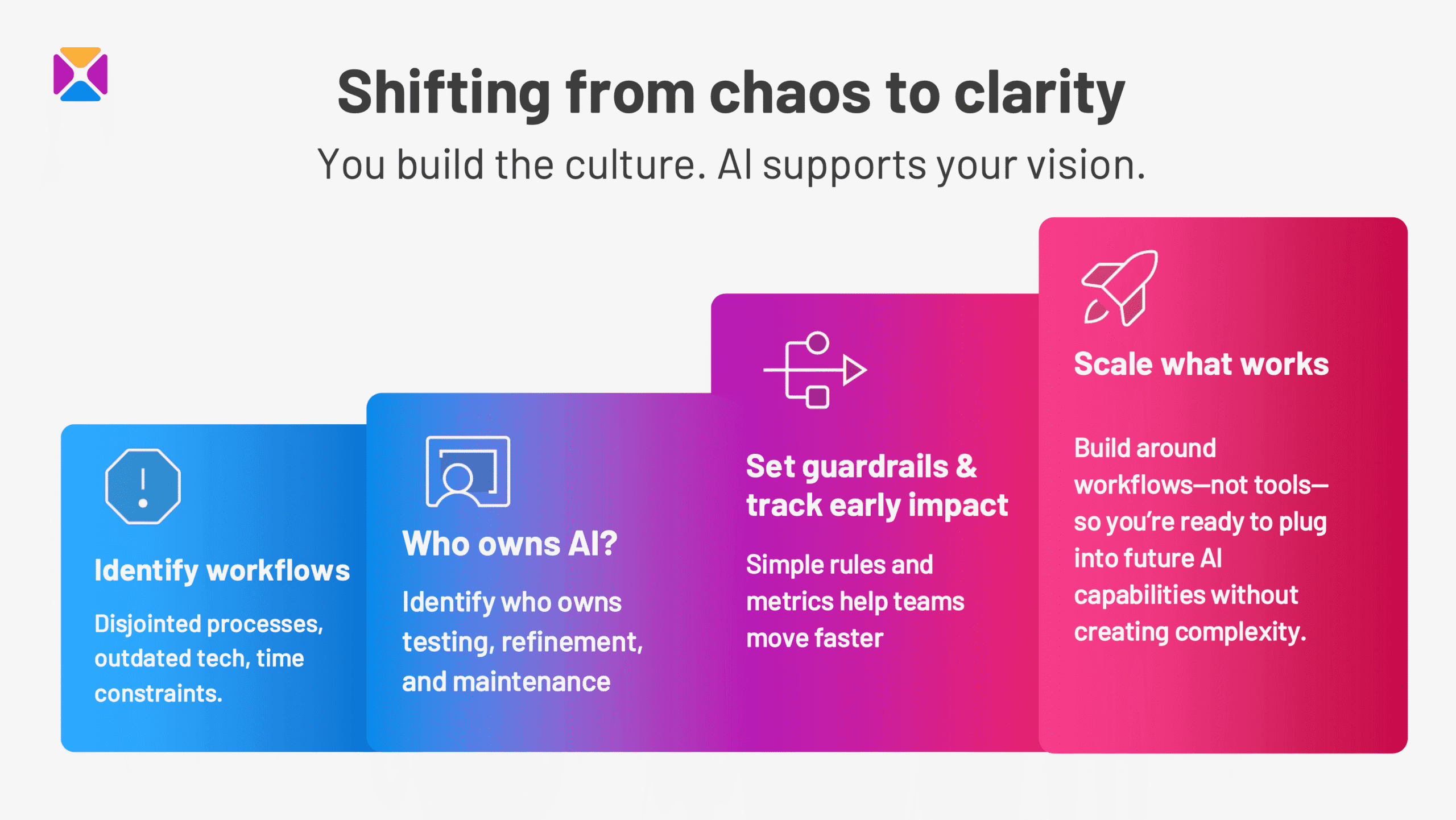
Turning disconnected workflows into streamlined systems
This approach keeps implementation manageable while delivering measurable results.
Real world AI for real world outcomes
AI is not just about automation. It is about improving outcomes across the organization.
Medical fitness centers are already using AI to:
- Predict churn and improve retention
- Forecast revenue and optimize capacity
- Deliver personalized outreach at scale
- Support staff with real-time insights and recommendations
AI also enables conversational support across web, mobile, and messaging channels, allowing members to get answers instantly while freeing up staff time.
The result is a more responsive, efficient, and member-centered operation.
Key takeaway
AI is quickly becoming a practical necessity for medical fitness centers that want to remain competitive, improve engagement, and demonstrate outcomes.
The most successful organizations are not those experimenting randomly, but those applying AI strategically to real workflows that impact member experience and operational efficiency.
By combining unified data, thoughtful guardrails, and a phased adoption strategy, medical fitness centers can turn AI from a concept into a measurable advantage.
Watch the webinar recording
If you missed the live session, you could still explore the full framework, real-world examples, and step-by-step guidance shared by our experts.
Common questions about AI in medical fitness and how to get started
1. What is AI in medical fitness centers
AI in medical fitness centers uses data to improve member engagement, automate workflows, and generate insights from participation and operational data. If you want to see real examples in action, our upcoming webinar walks through practical use cases used by leading centers.
2. How can AI improve member engagement in medical fitness
AI helps identify at-risk members, personalize communication, and recommend programs based on behavior and health goals. In the webinar, we’ll show how these strategies can be implemented without adding complexity for your team.
3. What are real world examples of AI in medical fitness
Common examples include automated outreach, retention tracking, onboarding support, and reporting dashboards. The webinar will highlight real-world scenarios and workflows that medical fitness centers are using today.
4. Is AI safe to use in medical fitness environments
Yes, AI is used to support operations and communication while keeping humans in control of decision-making. The webinar also covers best practices for responsible AI use, including privacy, oversight, and compliance considerations.
5. How does AI help with reporting and outcomes
AI can turn raw participation and engagement data into meaningful reports that show program effectiveness and member progress. During the webinar, we’ll demonstrate how AI simplifies reporting for leadership and stakeholders.
6. Do I need a unified platform to use AI effectively
AI works best when data is centralized across scheduling, billing, and engagement tools. In the webinar, we explain why unified platforms are critical and how they enable more accurate insights.
7. How can medical fitness centers get started with AI
The best approach is to start small with high-impact workflows like communication or reporting, then expand gradually. Our webinar includes a simple 60-to-90-day roadmap to help you get started with confidence.
8. What will I learn from the AI webinar
You’ll learn practical AI use cases, how to improve member engagement, how to streamline operations, and how to use data to demonstrate outcomes. You’ll also see examples tailored specifically for medical fitness centers.