The complete fitness club management software buyer's guide for 2026

Features to require, red flags to watch for, an honest platform-by-platform comparison, and a 12-question buyer checklist, everything enterprise fitness clubs, health clubs, and multi-location gym operators need to make the right decision.
All-in-one fitness club management software is the operational backbone of every fitness club, the system that manages how members join, how they pay, how they access your facilities, and how your team monitors and retains them. The best fitness club management software for enterprise health clubs connects membership management, billing, scheduling, CRM, access control, and analytics on one platform instead of multiple platforms. This guide covers every feature that matters, which platforms deliver to them, and exactly what to ask before you sign.
Choosing the all-in-one fitness club management software is one of the most consequential operational decisions a fitness club makes and one of the most rushed.
Clubs that choose the wrong platform typically discover it six months post-implementation, when the billing workarounds have compounded, the staff are managing two systems instead of one, and the membership data that should be driving retention decisions is spread across exports, spreadsheets, and three different dashboards.
This guide is designed to prevent that outcome. It covers what fitness club management software needs to do, which features separate enterprise-grade platforms from boutique tools adapted upward, and how to evaluate any platform against the 12 questions that reveal operational fit before you commit.
| 97%+ Target quarterly collection rate |
$300–$800 Typical monthly cost for full software stack |
3% Target quarterly churn rate |
60%+ Member app adoption target |
|---|---|---|---|
| Requires integrated billing | Source: Industry 2026 estimates | Healthy enterprise benchmark | For clubs 6+ months post-launch |
Sources: Club Automation operational benchmarks; industry software pricing data; IHRSA member retention research
What is fitness club management software and what should it actually do?
Fitness club management software is the core management platform that handles how fitness clubs create, manage, bill, and retain memberships. At the enterprise level, it must do significantly more than track member records and process payments, it must connect membership data to billing, scheduling, access control, CRM, and real-time reporting in one operational system. For multi-location clubs, it must do all of that across every site from a single database.
The baseline definition is well understood: member records, payment processing, contract management. But the features that actually determine operational performance are the ones that connect those basics to everything else a club does.
A health club management software that stores member data but does not connect it to billing events, scheduling patterns, and CRM outreach is a database, not a management system. The distinction matters because the revenue a club loses to preventable churn almost always flows through the gaps between disconnected systems, not through failures within individual tools.
What features should fitness club management software have?
Not all fitness club management software features are equally important. Here are the capabilities that separate enterprise-grade platforms from tools designed for simpler operations; organized by operational functions.
1. Core membership management
The foundation every platform must have. Evaluate the depth, not just the presence.
- Member profiles with full history: Every visit, purchase, communication, and billing event — in one record, accessible at any location
- Complex membership structures: Family accounts, corporate groups, multi-tier dues, prorated charges, freeze and hold cycles — configurable without custom development
- Contract and waiver storage: Documents stored within the member profile, with expiry tracking and legal compliance audit capability
- Self-service member portal: Members update payment methods, view history, manage freezes, and book services without front-desk contact
- Membership lifecycle automation: Renewal reminders, expiry sequences, and win-back workflows triggered automatically — not manually
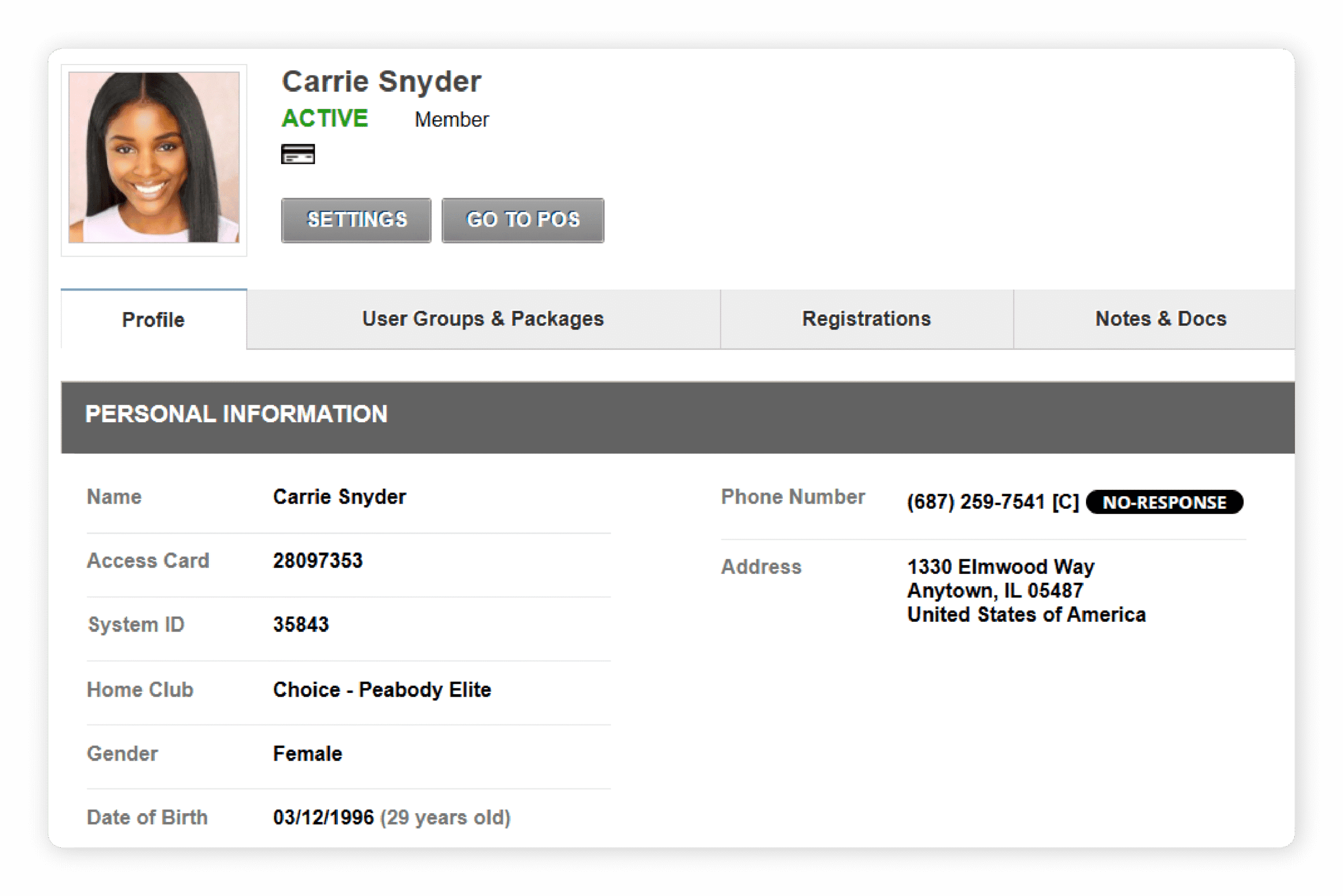
Club Automation – Member Profile View
2. Billing and payment processing
The revenue protection layer. This is where the most preventable losses occur in most clubs.
- Automated EFT and credit card billing: Recurring dues on monthly, biweekly, weekly, or daily cycles — without manual intervention
- Intelligent retry logic: Failed payments retried on a configurable, intelligent schedule — not a fixed ‘retry in 7 days’ rule
- Account updater: Expired and reissued card details refreshed automatically before a payment is attempted
- PCI Level 1 compliance: The highest certification tier — required for high-volume enterprise card processing
- Multi-location billing consolidation: One database, one collection rate view, one aged balance report across the entire club network
- Flexible fee structures: Transparent surcharge options (Flex Fees) that offset processing costs without hidden add-on charges
The right payments & billing software can help reduce payment issues, improve collections, and create a smoother member experience. Discover the key considerations every club operator should evaluate before making a decision.
3. Scheduling and facility management
Membership value is realized through usage. Scheduling connects membership to the member experience.
- Unified class and facility calendar: Group fitness, personal training, aquatics, and facility bookings in one view — not separate systems per department
- Real-time member app sync: Schedule changes visible to members immediately — no delay, no discrepancy between back-office and member-facing view
- Resource conflict management: Automatic conflict detection before a double-booking occurs — not after a member has already arrived
- Utilization reporting: Which time slots are underperforming? Which are generating waitlists? Data that drives schedule optimization
- Multi-location scheduling visibility: Corporate operators see all club calendars from one dashboard without logging into separate instances
Scheduling shouldn’t slow down your staff or frustrate your members. Discover how modern gym scheduling software helps clubs streamline bookings, reduce administrative work, and create a smoother member experience.
4. CRM and member retention
The engagement layer. This is where churn is prevented — before a cancellation decision is made.
- Behavior-based outreach triggers: Automated sequences that fire when a member’s visit frequency drops, a payment fails, or a trial is expiring
- Lead pipeline management: From first enquiry through trial to paid membership — with hot lead notifications in under 60 seconds
- Staff daily agenda: Structured follow-up workflow with integrated scripts — so retention quality does not depend on individual staff motivation
- Billing-to-CRM integration: Payment failures visible in the CRM and triggering outreach — not siloed in a separate billing module
- AI-powered personalized messaging: SMS and email adapted to each member’s actual behavior data and the club’s configured voice
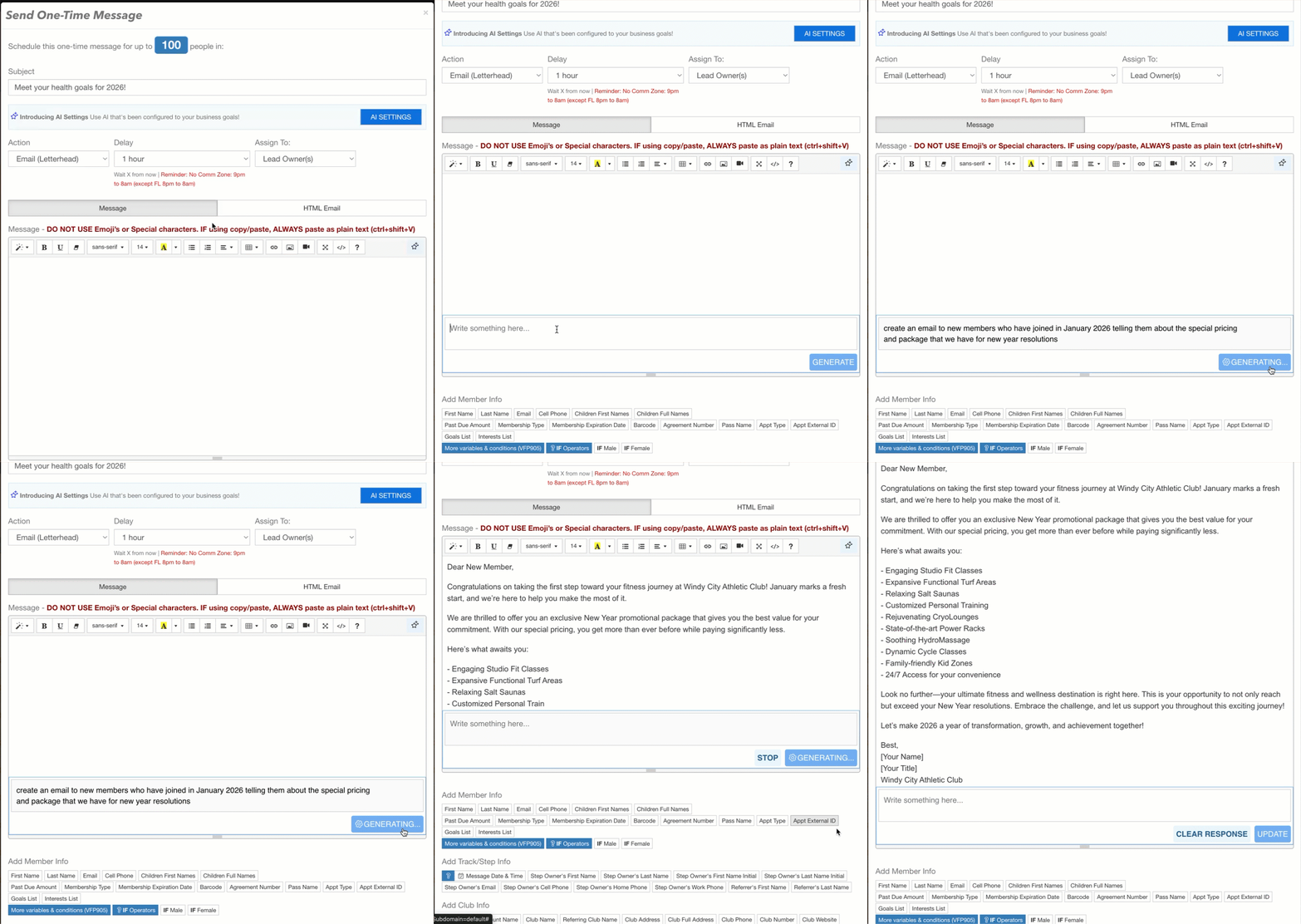
Daxko Engage Pro – AI composition tool
Your CRM should do more than store member information. Discover what the best health club CRMs have in common and how the right solution can streamline sales, automate follow-up, and help you grow membership revenue.
5. Access control
Membership access is both a member experience and a security function. Both require native integration.
- Integrated 24/7 access: Key fob and barcode access controlled by membership type — natively, without third-party integration
- Automatic permission changes: Membership cancellations, freezes, and tier changes reflected in access control immediately — not on a nightly sync
- Remote management capability: Manage access rules across all locations without on-site visits
- Off-peak security monitoring: Access event logs with anomaly detection for 24/7 facilities
6. Reporting and analytics
Operational intelligence. The difference between managing by intuition and managing by data.
- Real-time dashboards: Membership health, daily check-in volumes, collection rates, churn signals — live, without manual exports
- Multi-location performance comparison: Network-wide KPI view with location-level drill-down from one dashboard
- Customizable report builder: Create and save reports specific to your club’s operational priorities
- Scheduled report delivery: Automated report delivery to configured stakeholders on a set cadence
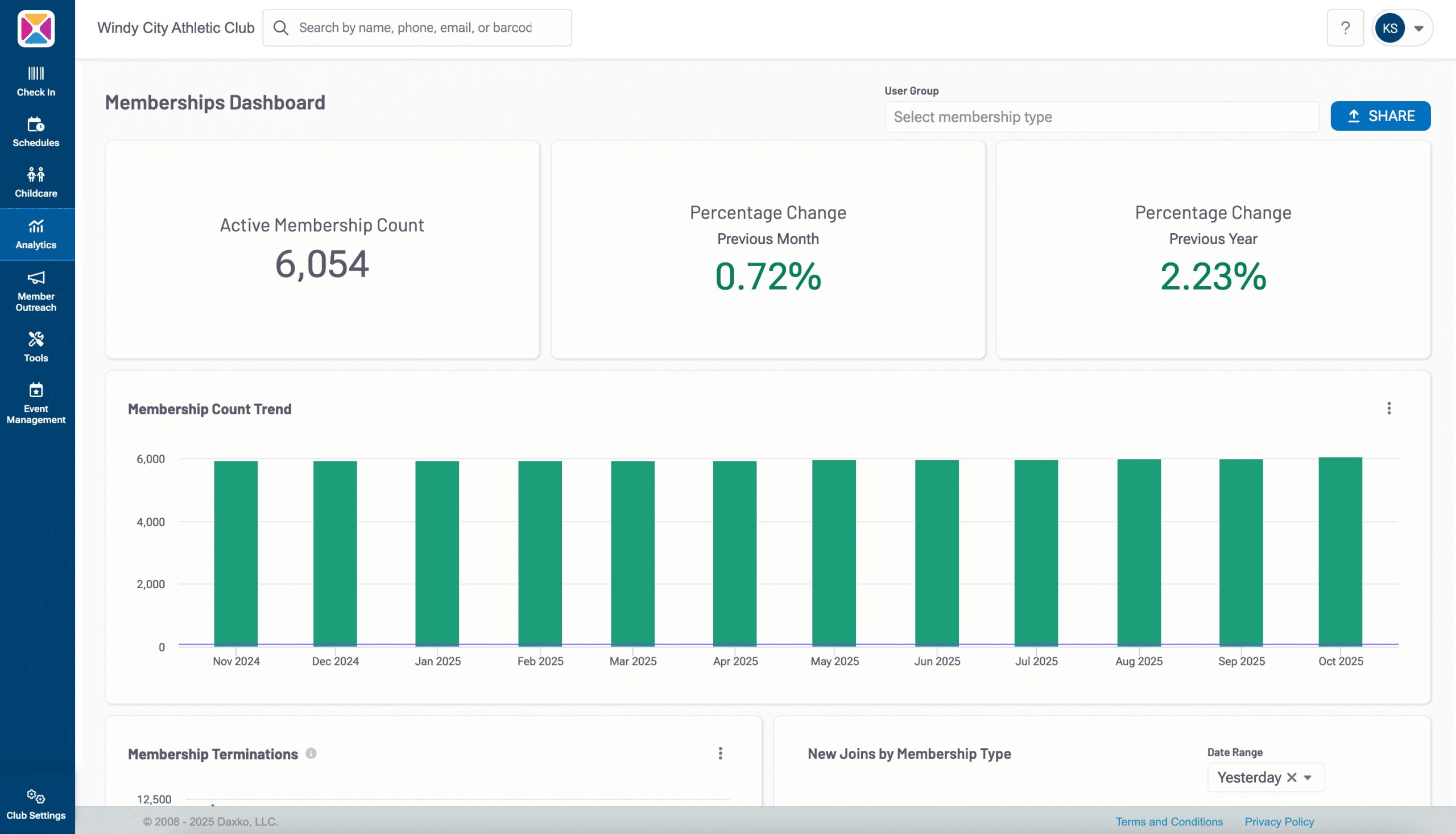
Club Automation – Membership Dashboard
Stop relying on month-end reports to tell you what already happened. Discover the dashboards fitness club operators should review every week to spot trends early, improve retention, and make smarter operational decisions.
What's the best fitness club management software out there? A platform comparison
The best fitness club management software depends almost entirely on your club’s size and operational complexity. There is no universally ‘best’ platform — there is the right platform for your specific operation. This comparison is honest about where each platform leads and where it falls short, because the wrong fit costs more in operational disruption than any platform saves in monthly subscription fees.
Here is an honest, feature-grounded comparison of the leading platforms by operational segment:
1. Daxko Club Automation
Best for: Enterprise health clubs, multi-location chains, multi-purpose athletic clubs with pools, aquatics, and courts
Key membership features: Complex membership structures (family, corporate, multi-tier), advanced EFT/billing with SmartDate retry, native access control (PCI L1), unified scheduler for all facility types, Daxko Engage Pro CRM with billing-connected outreach, real-time multi-location dashboards
Pricing: Custom enterprise pricing — contact for quote. Flex Fees available to offset processing costs
Strengths: Purpose-built for enterprise complexity. One database across all locations. White-glove US-based implementation. Strongest billing and revenue recovery capability in category. Native access control.
Limitations: Not designed for small studios or personal training businesses.
2. Mindbody
Best for: Boutique fitness studios, yoga/Pilates/spin centers, wellness spas, consumer marketplace-driven businesses
Key membership features: Class scheduling and appointment booking, consumer marketplace (Mindbody Explore app), basic recurring billing, marketing automation in premium tiers
Pricing: Published pricing: ~$129–$599+/month depending on tier. Consumer marketplace charges 20% per new client acquired through the app
Strengths: Strong consumer marketplace for boutique discovery. Familiar interface. Large user community. Wide third-party app ecosystem.
Limitations: Studio/spa-first architecture — limited for complex membership structures or multi-amenity facility management. Requires third-party access control. Add-ons drive total cost significantly above base price.
3. ABC Fitness
Best for: Large gym chains, national fitness franchises, high-volume multi-location operators with standardized programming
Key membership features: Franchise-level membership management, high-volume billing, standardized chain-wide reporting, franchise operations control
Pricing: Enterprise pricing — contact for quote
Strengths: Strong at franchise standardization. High-volume billing proven at scale. Good for uniform, repeatable operations across large franchise networks.
Limitations: Less configurable for multi-purpose facilities or complex aquatics/courts operations. Less intuitive for staff at location level according to user reviews.
4. Daxko Zen Planner
Best for: CrossFit gyms, martial arts schools, boutique single-location clubs, fitness businesses with 50–300 members
Key membership features: Membership management, class scheduling, automated billing, built-in CRM tools, workout tracking (for CrossFit/functional fitness)
Pricing: ~$99–$348/month depending on membership count
Strengths: Strong CRM and member communication for independent gyms. Good workout and performance tracking for CrossFit/functional fitness. Clean interface. Reasonably priced for its feature set.
Limitations: Not designed for enterprise or multi-location operations. Limited facility management for pools or courts. Less robust billing for complex membership structures.
5. PushPress
Best for: CrossFit boxes, independent gyms, personal training studios, fitness businesses under 200 members
Key membership features: Membership management, class booking, automated billing, basic CRM, member app
Pricing: Free tier available (limited). Paid from ~$159/month
Strengths: Strong for CrossFit and functional fitness communities. Clean member app experience. Quick self-service setup.
Limitations: Not designed for enterprise health clubs or multi-location operations. Limited advanced billing. No native access control. Reporting depth insufficient for enterprise operations.
Which fitness club management software offers the best features for enterprise clubs?
For enterprise health clubs, Daxko Club Automation offers the most complete feature set for operational complexity — combining advanced billing, native access control, unified multi-facility scheduling, purpose-built CRM (Daxko Engage Pro), and real-time multi-location reporting in one platform. For boutique studios Daxko Zen Planner offer better-fitting feature depth at their price points. The best features are the ones that match your club’s specific operational requirements, not the platform with the longest feature list.
The 3 features most underweighted in fitness club management software evaluations
- Billing failure → CRM outreach connection. Most platforms handle billing and CRM separately. When a payment fails, there is either a manual step required to trigger member outreach, or a configured workflow that depends on a third-party integration. For enterprise clubs processing thousands of transactions per month, this gap silently costs members every billing cycle.
- Multi-location single-database architecture. ‘Multi-location support’ is a marketing phrase that masks significant architectural differences. Some platforms support multiple locations through separate accounts with shared reporting. Others — like Club Automation — maintain one actual database across all locations, so a member’s record is identical at every site. Ask specifically: is this one database or multiple instances with reporting integration?
- Native vs. integrated access control. Access control is either built into the membership platform or requires a third-party integration. Native access control means membership status changes (cancellation, freeze, tier change) are reflected in door access immediately. Integrated access control means there is a sync delay and a potential point of failure between the membership system and the physical door.
Looking for the best fitness club management software for memberships? Here's what to compare
When comparing fitness club management software for memberships specifically, these are the dimensions that produce the most meaningful differentiation between platforms:
| Comparison dimension | What strong looks like | What weak looks like |
|---|---|---|
| Membership complexity handling | Family, corporate, multi-tier, prorated, freeze — all native. Demos with your most complex real-world scenario. | Simple memberships only, or complex structures requiring manual workarounds / custom development |
| Billing architecture | Intelligent retry, account updater, PCI L1 native, multi-location billing consolidation | Basic retry, no account updater, PCI L2/3, per-location billing reports that need manual aggregation |
| CRM connection | Billing failures trigger CRM outreach automatically. Visit frequency drops trigger re-engagement. All from one database. | Billing and CRM are separate systems requiring manual coordination or webhook configuration |
| Access control | Native integration — membership changes reflected in door access immediately | Third-party integration with sync delays between membership status and physical access |
| Multi-location support | One database, one member record at all sites, one real-time dashboard across the network | ‘Multi-location’ means separate instances with shared reporting, or per-location logins |
| Reporting | Real-time dashboards, no manual exports, multi-location rollups, customizable KPI views | Monthly exports, limited real-time data, per-location reports requiring manual consolidation |
| Implementation model | Dedicated specialist, tailored configuration, staff training included, realistic timeline stated upfront | Self-service setup, documentation-only onboarding, ‘go live in 48 hours’ claims |
What are the best fitness club management software providers with integrated payments?
For fitness club management software with genuinely integrated payments — where billing, CRM, and membership data share one database, and billing events automatically trigger downstream actions — Club Automation is the strongest option for enterprise health clubs. Mindbody and PushPress include payment processing, but the depth of integration (particularly billing-to-CRM connection and intelligent retry logic) varies significantly between platforms.
The phrase ‘integrated payments’ covers a spectrum. At the basic end, it means a platform that processes card payments without requiring a separate Stripe or Square account. At the advanced end, it means a billing system connected to every downstream operational function; where payment events trigger CRM actions, membership status updates, access control changes, and real-time dashboard updates simultaneously.
Key questions to ask about payment integration in any platform:
- When a payment fails, what happens automatically in the next 60 minutes? (This reveals whether billing and CRM are truly integrated)
- Does an account updater come included, or is it a separate cost? (Expired card updates prevent a significant share of preventable declines)
- What is the PCI compliance tier? (Level 1 is the enterprise standard; Level 2/3 leaves higher residual risk)
- How are billing failures reported across multiple locations? (One dashboard or per-location exports?)
Club Automation is the right choice for large health clubs, multi-location operators, and multi-purpose facilities where operational complexity, billing precision, and data integrity across sites are primary requirements.
The 12-question buyer checklist: What to ask before you sign
Use these 12 questions in every vendor evaluation. Ask for live demonstrations of each answer — not slides, not written descriptions, not ‘yes we have that’ without evidence.
| # | Question to ask the vendor | Why it matters |
|---|---|---|
| 1 | Is this one database across all locations, or separate instances? | The answer determines whether you’ll ever have truly unified member records — or just consolidated reporting |
| 2 | Show me a family membership with two adults, two children, different access levels, in a live demo | Reveals whether complex membership structures are native or require workarounds |
| 3 | What happens automatically when a payment fails at 2am today? | The most important retention question — reveals billing-CRM integration depth |
| 4 | Is access control native to this platform or a third-party integration? | Native = immediate status sync. Third-party = sync delay and a potential failure point |
| 5 | Show me yesterday’s collection rate across all locations — right now, without exporting anything | Tests whether reporting is genuinely real-time or export-dependent |
| 6 | What is your PCI compliance tier — Level 1, 2, or 3? | Level 1 is the enterprise standard. Lower tiers mean higher residual security risk at scale |
| 7 | Is an account updater included, or is it a separate cost? | Expired card prevention is high-ROI at scale — should be native, not billed per refresh |
| 8 | Show me the staff daily workflow for member follow-up — what does it look like on a Monday morning? | Reveals whether CRM is structured for staff or whether retention depends on individual memory |
| 9 | What is the realistic timeline from contract signing to staff using this effectively — not just ‘going live’? | The most misrepresented metric in any software sales process |
| 10 | Which type of club or gym is this platform not right for? | A vendor who can’t answer this is optimizing for the sale, not your outcome |
| 11 | What does total cost look like — subscription plus processing fees, add-ons, and implementation? | Headline price rarely reflects true cost at enterprise scale |
| 12 | Show me the mobile app your members use — book a class, update a payment method, and check their schedule | Tests whether member-facing UX matches operational claims |
Bring the checklist to your Daxko Club Automation demo
Club Automation is built for enterprise health clubs that need one platform — not six. Bring any or all 12 questions to a live demo, and we’ll demonstrate every answer with real data from a configured environment that reflects your club’s actual membership complexity.
Frequently Asked Questions about fitness club management software
Q: What is fitness club management software?
Fitness club management software is the core management platform that handles how fitness clubs create, manage, bill, and retain memberships. At the enterprise level, it connects membership data to billing, scheduling, access control, CRM, and analytics in one system. The best fitness club management software for large health clubs operates from a single database across all locations — so every staff member at every site has the same real-time view of every member.
Q: What’s the best fitness club management software?
The best fitness club management software depends on your club’s size and complexity. For enterprise health clubs (500+ members, multiple locations, complex billing): Daxko Club Automation is purpose-built for this operational profile — with advanced billing, native access control, unified scheduling, and Daxko Engage Pro CRM in one platform.
Q: Which fitness club management software offers the best features?
For enterprise health clubs, Club Automation offers the most complete feature set for operational complexity: complex membership structures (family, corporate, multi-tier), advanced billing with SmartDate retry and account updater, native 24/7 access control (PCI Level 1), a unified multi-facility scheduler, billing-connected CRM through Daxko Engage Pro, and real-time multi-location reporting dashboards. For boutique studios, Mindbody offers the most feature depth at the small business scale.
Q: How much does fitness club management software cost?
Fitness club management software pricing varies significantly by platform and club size. Boutique and small gym platforms range from ~$350/month. Mid-market platforms start at ~$129–$599+/month, with essential features often requiring add-ons. Enterprise platforms including Club Automation use custom pricing based on membership count, location number, and feature set. Industry estimates suggest full software stack costs of $300–$800/month for the majority of fitness businesses. Total cost of ownership including processing fees, add-ons, and staff time savings is the more meaningful comparison than subscription headline price.
Q: Does Club Automation work for small gyms?
Club Automation is designed and optimized for enterprise health clubs and multi-location fitness operations. For small gyms (under 200 members), single-location boutique studios, or personal training businesses, the platform’s feature depth and enterprise pricing model will be disproportionate to operational needs. Platforms like Zen Planner are more appropriate fits at that scale.
Q: Is fitness club management software worth it?
For any fitness club processing more than ~100 memberships, fitness club management software is worth it and typically pays for itself in recovered billing revenue alone. Research shows that 1 in 3 declined cards leads to a cancelled membership when not proactively managed. A platform with intelligent retry logic, account updater, and CRM-connected outreach recovers a significant portion of that revenue. The return on investment calculation should include staff hours saved on manual billing management, percentage of declined payments recovered, member churn reduction from automated retention workflows, and scheduling optimization value from utilization reporting.
Q: What fitness club management software is best for multi-location clubs?
For multi-location fitness club management software, the key requirement is a single database across all sites, not separate platform instances with shared reporting. Club Automation maintains one member database across all club locations, with centralized billing consolidation, unified scheduling visibility, and multi-location CRM performance dashboards accessible from one login. Members who visit any location in the network appear in the same profile with the same history, eliminating the data fragmentation that plagues multi-location operators using per-site tools.