How AI becomes the 24/7 operating system for fitness club operations

AI in fitness is not about adding more tools. It is about embedding intelligence directly into the systems that already run your business so that operations become consistent, scalable, and driven by real member data.
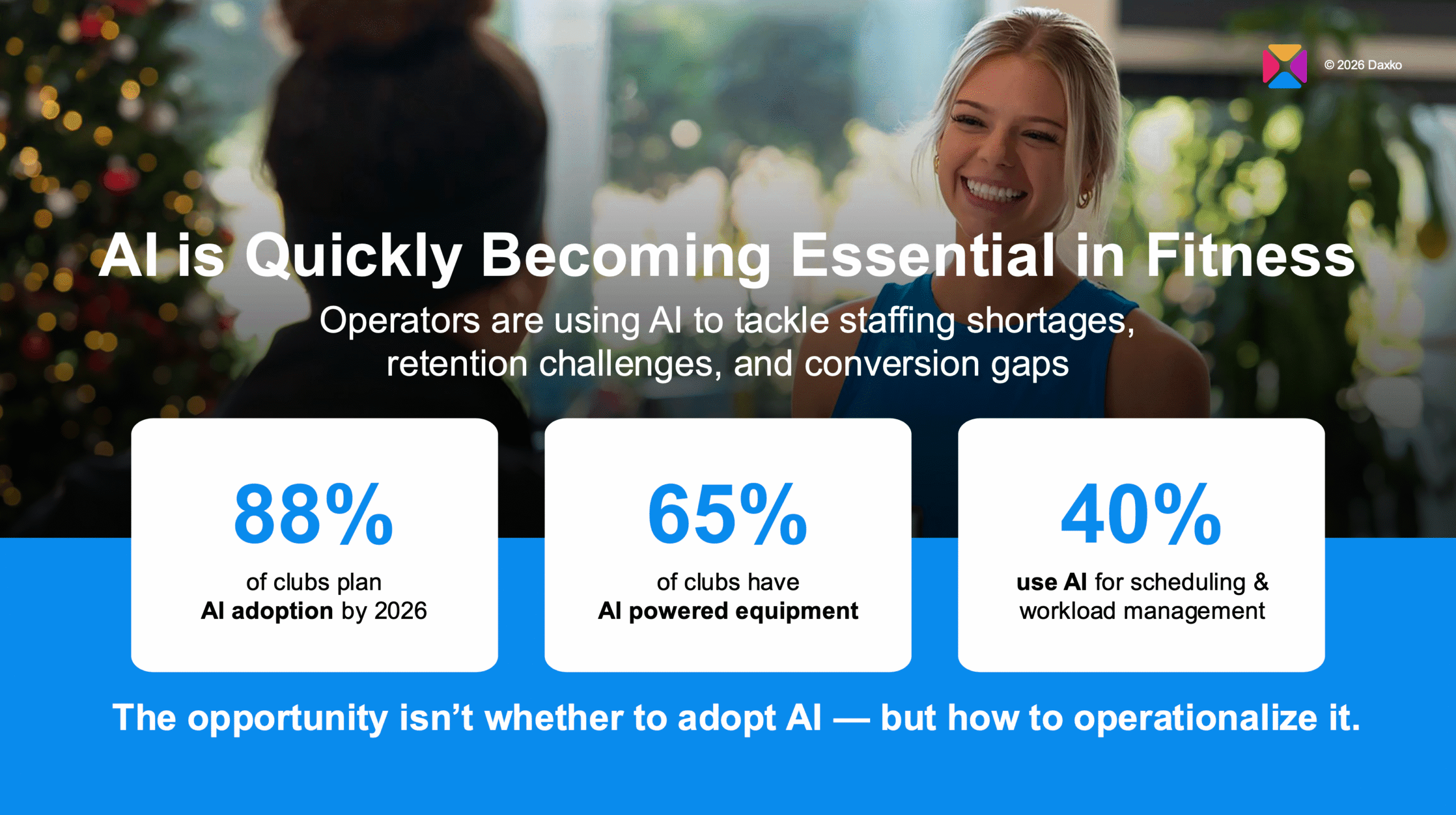
At HFA 2026, I talked about this exact shift. What we are seeing across the industry is clear. AI adoption is accelerating rapidly, with 88% of clubs planning to adopt AI by 2026, but most operators are still approaching it in a way that creates more complexity instead of less.
The opportunity is no longer whether to adopt AI. It is how to operationalize it.
AI adoption statistics
Why is AI adoption accelerating in fitness?
AI adoption is accelerating because operators need to solve real operational constraints around staffing, retention, and conversion. Clubs are expected to deliver faster responses, more personalized engagement, and consistent service without increasing headcount.
Across the market, 65% of clubs already use AI-powered equipment and 40% use AI for scheduling and workload management, which shows that adoption is not theoretical anymore.
However, most of this adoption is happening outside the core system. That is where the problem begins. When AI is introduced as a separate layer instead of being embedded into operations, it increases fragmentation instead of improving execution.
Why do most AI approaches fail in club operations?
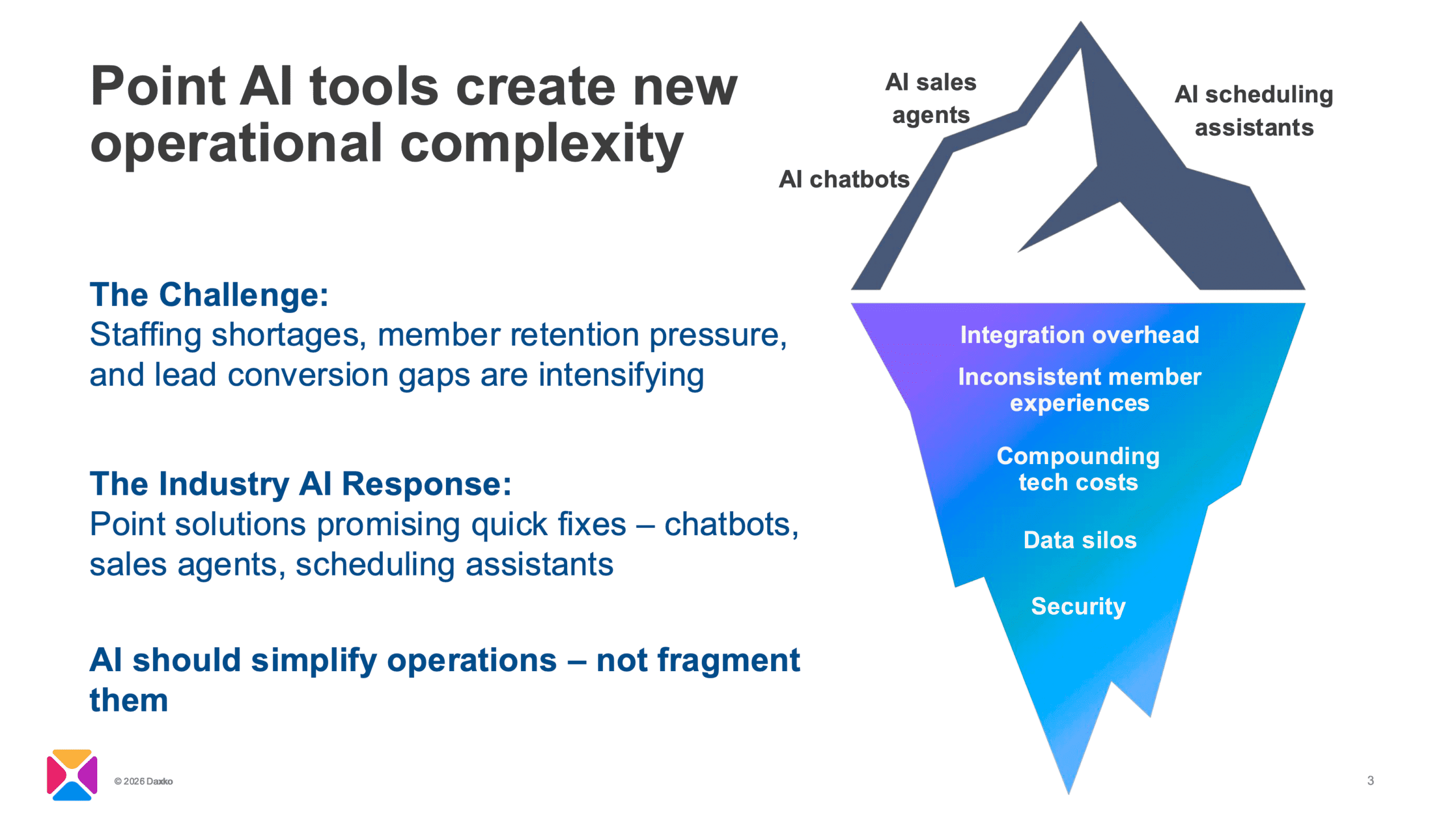
Most AI approaches fail because they rely on disconnected point solutions that sit outside the system of record and operate without full business context.
The current market response has been to introduce chatbots, AI sales tools, and scheduling assistants as separate systems. These tools promise speed, but they create new operational issues. Data becomes fragmented, systems require constant integration work, member experiences become inconsistent, and security risks increase.
This is not a theoretical issue. It shows up in daily operations when staff have to move between systems, reconcile data, and manage workflows manually. AI should simplify operations. When it creates additional systems to manage, it is solving the wrong problem.
Point AI tools and operational complexity
What is an intent-driven club?
An intent-driven club is one where the system understands member behavior and automatically drives the next best action across operations, marketing, and engagement.
This is a fundamental shift from task-based execution to system-led execution. Instead of staff deciding what to do next, the system continuously evaluates member activity, billing status, engagement patterns, and operational signals to determine what action should happen.
This means the system can prioritize which leads need follow-up, which members are at risk, which billing issues need attention, and where staff should focus their time.
AI is not replacing decision-making. It is structuring it so that execution becomes consistent across the business.
Why must AI be embedded in the Membership Management Systems?
AI must be embedded in the Member Management System (MMS) because that is where operational truth lives and where execution happens.
When AI sits outside the MMS, it lacks the context required to operate effectively. It cannot reliably access billing status, attendance behavior, engagement history, or lifecycle stage. This leads to generic communication, inconsistent workflows, and poor member experiences.
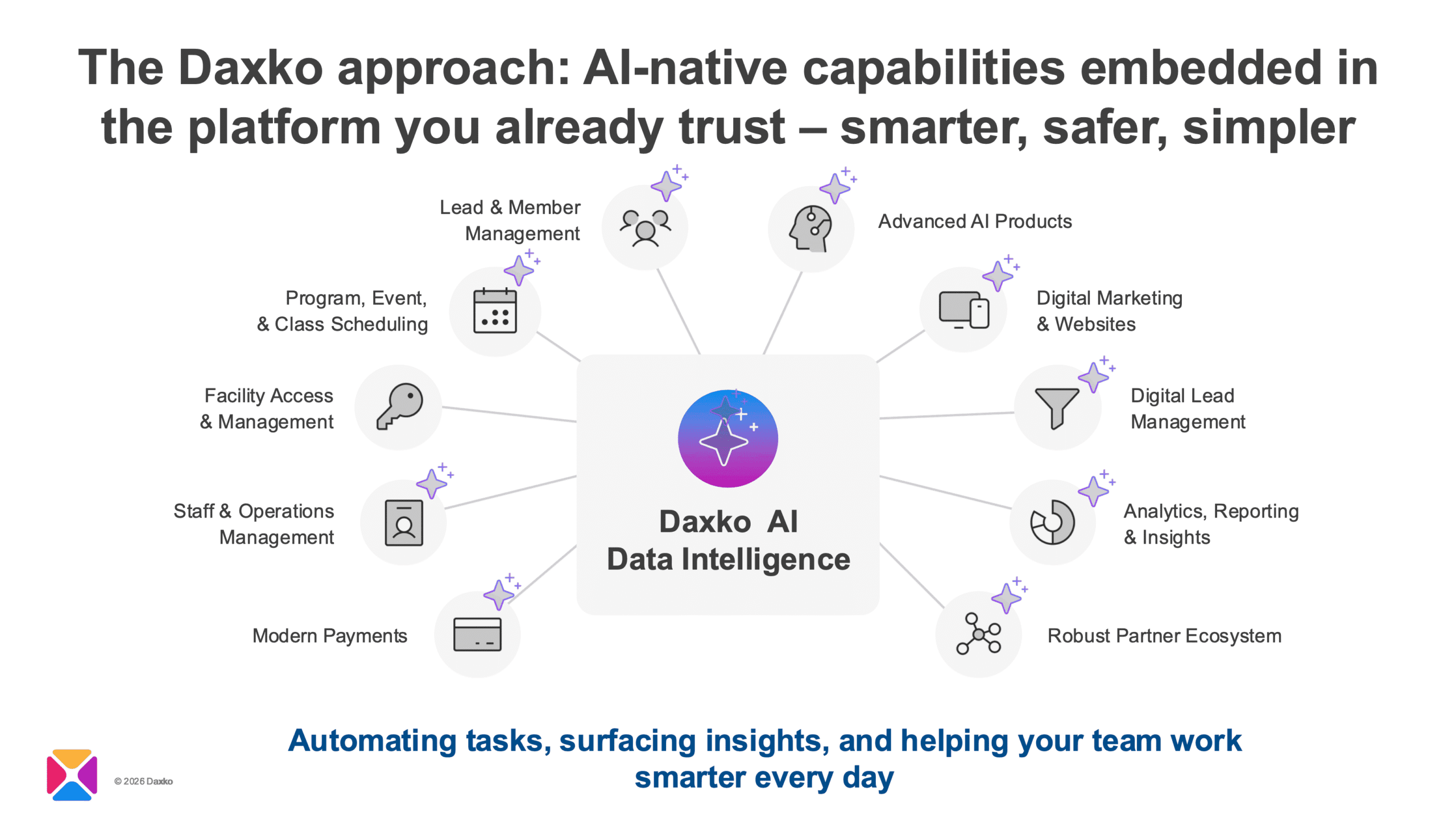
When AI is embedded inside platforms like Club Automation and Daxko Engage Pro, it operates directly on real-time operational data. That includes member records, scheduling systems, billing systems, and communication history.
This eliminates duplication, reduces latency, and ensures that every action reflects the current state of the business. Embedded AI is not about adding capability. It is about improving execution.
Embedded AI platform view
What data powers effective AI in fitness?
Effective AI in fitness is powered by unified operational data, not external prompts or generic datasets.
At Daxko, our AI intelligence is built on more than 25 years of fitness industry data and over 10 billion transactions annually. This data includes member behavior, billing and payment history, class attendance, digital engagement, and communication patterns.
Because this data is unified, AI can generate meaningful outputs such as churn prediction, lead prioritization, campaign triggers, and operational recommendations.
The relationship is direct. AI quality is determined by data quality and system integration. Without both, the output cannot be reliable.
How does AI improve daily club operations?
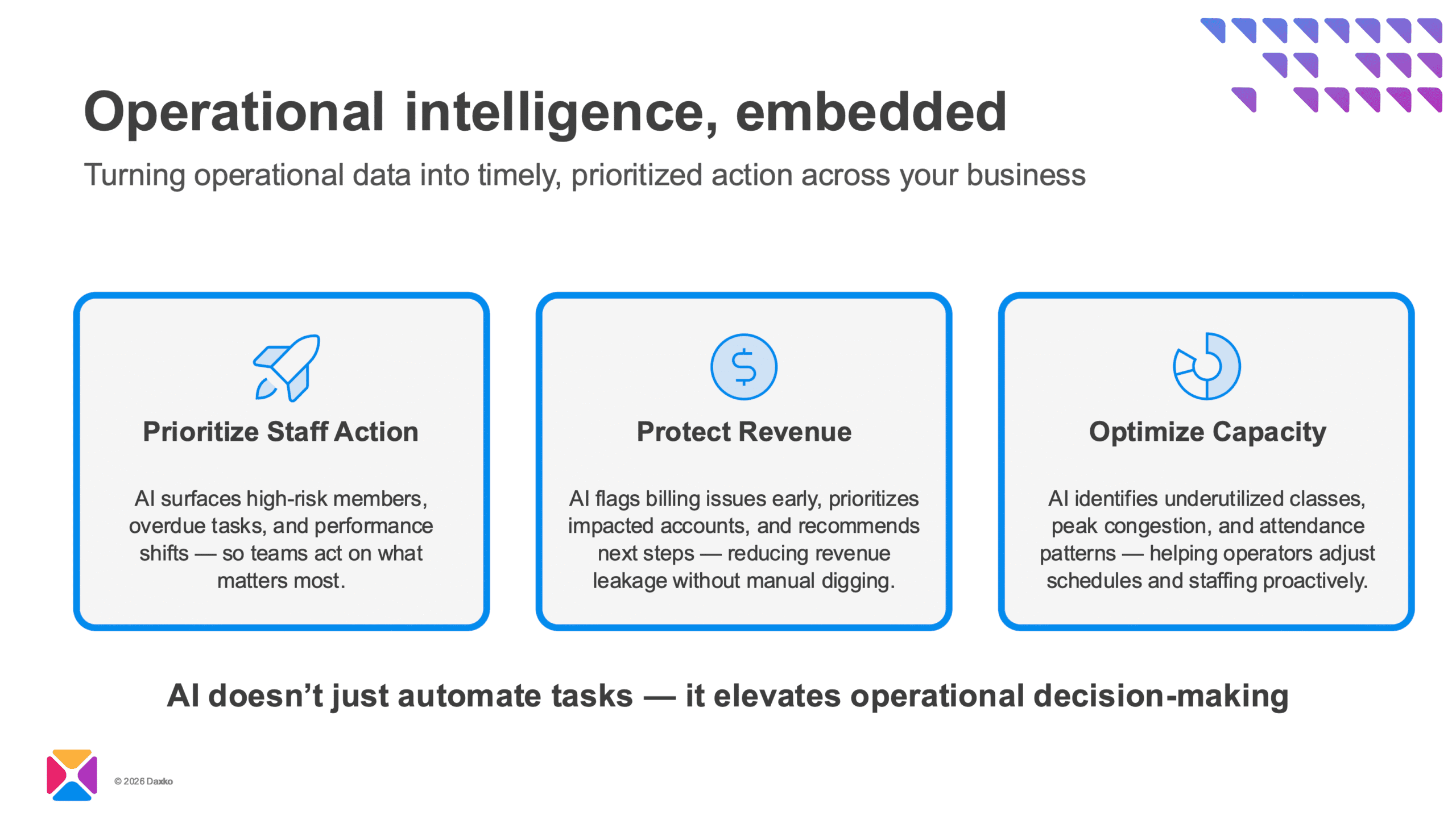
AI improves operations by turning operational data into prioritized, actionable workflows that run consistently across the business.
Instead of requiring staff to manually analyze reports, AI identifies billing issues early and surfaces them with recommended next steps. It evaluates member behavior to identify churn risk and prioritizes outreach before cancellation happens. It analyzes attendance and capacity trends to support scheduling decisions.
This is not about automation in isolation. It is about execution that is informed, timely, and consistent. AI does not replace tasks. It determines which tasks matter most and ensures they are handled correctly.
Operational intelligence examples
How does AI operate across the member journey?
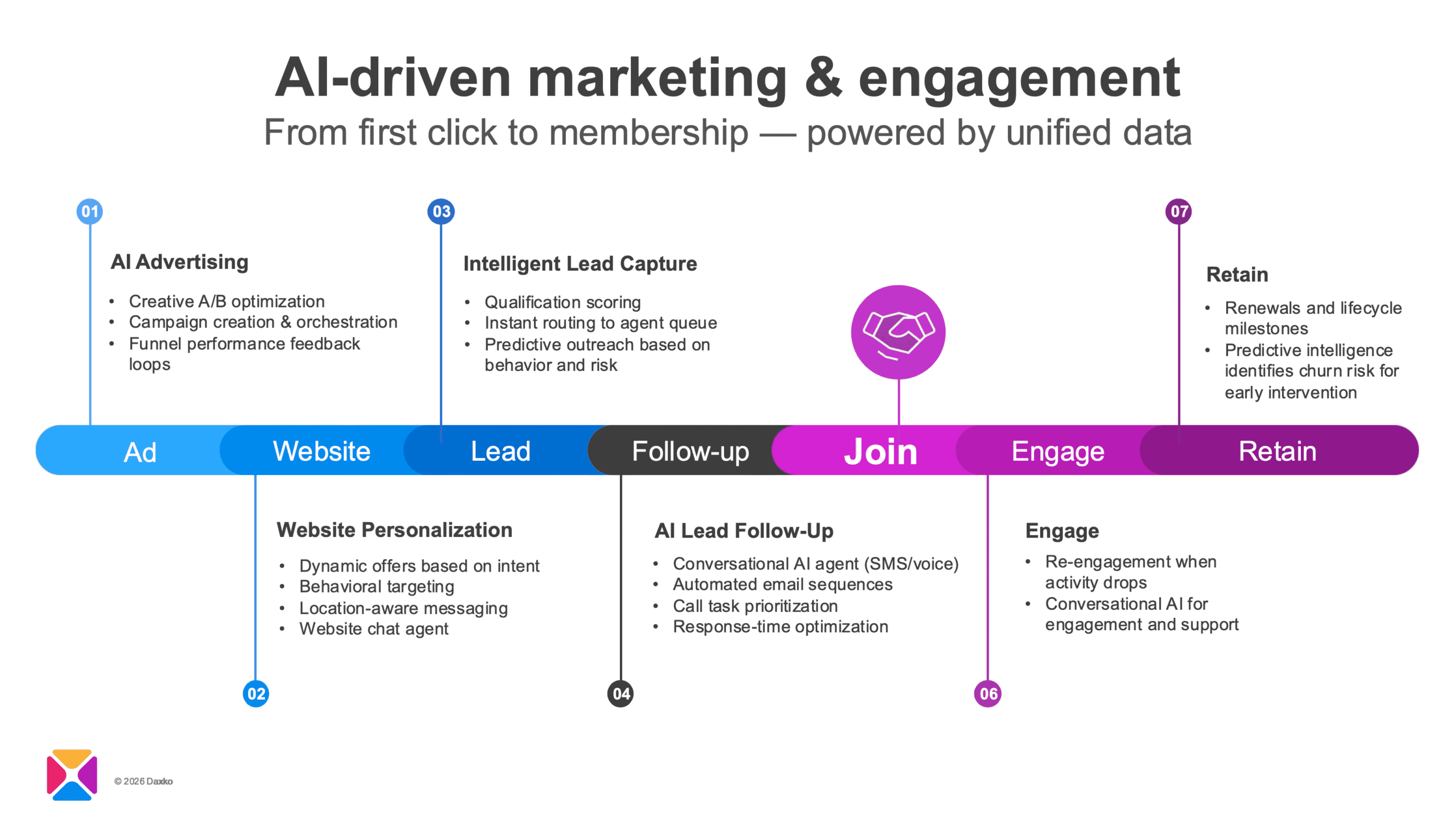
AI operates across the full member lifecycle by connecting acquisition, conversion, engagement, and retention into a single system.
From the first interaction to long-term retention, AI can evaluate data continuously and adjust actions accordingly. It can optimize advertising performance based on conversion data, trigger follow-up based on lead behavior, guide onboarding, and identify when a member is disengaging.
Because all of this is driven by unified data inside the system, every interaction is informed by what has already happened. This creates a continuous feedback loop where the system improves over time without requiring manual intervention.
Why are security and governance foundational?
Security and governance are foundational because AI operates directly on sensitive member data, including payments, personal information, and engagement history.
If AI is not governed, it introduces risk at the core of the business. That is why AI must operate within secure, controlled environments.
At Daxko, this includes enterprise-grade encryption, role-based access controls, audit trails, and governed APIs. Data is not used to train public models, and access is controlled at every level.
Security is not a feature. It is infrastructure. Without it, AI cannot be deployed responsibly at scale.
What architecture enables scalable AI?
Scalable AI requires a unified data layer, embedded intelligence, and a governed access model.
In practice, this means AI operates inside the platform through a controlled gateway that manages how data is accessed and used. Integrations are permissioned, audited, and aligned with the system of record.
This allows operators to extend capabilities without exposing data or breaking workflows. AI does not sit outside the system. It operates within it, under defined rules.
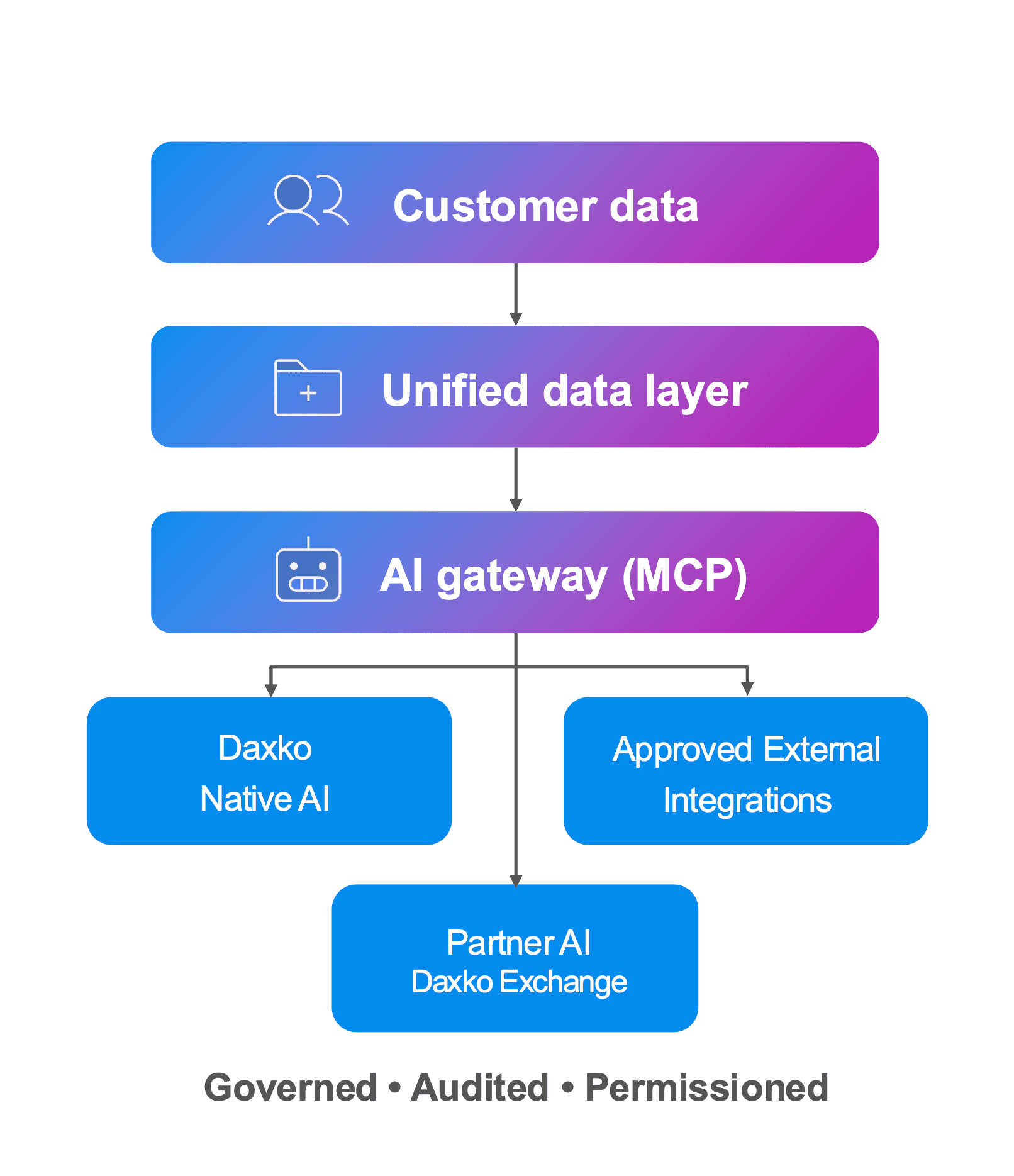
AI gateway architecture
What does the future of fitness operations look like?
The future of fitness operations is not defined by more tools. It is defined by connected systems that execute consistently based on real-time data.
Clubs will move from manual follow-up to system-triggered engagement. Communication will shift from generic messaging to behavior-driven interaction. Operations will shift from reactive decision-making to proactive, intent-driven execution.
This is not about adding automation. It is about embedding intelligence into the workflows that already run the business. AI will not be something operators use occasionally. It will be part of how the club operates every day.
Ready to see it in action?
If you want to understand how AI can improve operational execution and member engagement: Book a Demo with Daxko Club Automation
See how Daxko helps you unify data, embed intelligence into workflows, and deliver consistent member experiences at scale.
Frequently Asked Questions about AI in fitness operations
1. What is the biggest mistake clubs make with AI?
The biggest mistake is implementing AI as a standalone tool instead of embedding it within the member management system. This creates fragmentation and limits effectiveness.
2. Why does AI need to be embedded in the Member Management System?
Because the Member Management System (MMS) contains the operational data required for context. Without that data, AI cannot deliver accurate or relevant outcomes.
3. What determines AI performance?
AI performance is determined by the quality of operational data and the level of system integration. Without unified data, results will be inconsistent.
4. How does AI improve retention?
AI identifies early churn signals based on behavior and payment patterns and enables proactive intervention before members cancel.
5. Is AI replacing staff?
No. AI handles repeatable workflows and prioritizes actions, allowing staff to focus on member relationships and service.
6. What is the right way to implement AI?
The right approach is to embed AI into existing workflows within the system of record and focus on consistent, production-ready execution.